A dyeing mill performs the dyeing and finishing work itself, so the buyer controls the spec, the colour and the test results from the source; a fabric trader buys finished cloth from mills and resells it, adding choice, smaller quantities and service. The right channel depends on your order size and what you need to control.
What is the difference between buying from a dyeing mill and a fabric trader?
- Dyeing mill — a factory that performs commission dyeing and finishing: you send greige or a spec, and it bleaches, dyes and finishes the cloth for you.
- Fabric trader — buys finished fabric from dyeing mills and resells it to garment factories, uniform makers and exporters, offering many constructions and colours in one place.
- In short: buying from the mill means buying the process; buying from a trader means buying variety and service.
What do you gain buying direct from the dyeing mill?
- Spec control from the start — the colour side can start three ways: send a colour spec, send a sample to match, or pick from standard swatch cards.
- A dyeing route that fits the volume — a mill runs batch (jet) dyeing, continuous dyeing (which covers light to dark shades) and semi-continuous (cold pad batch).
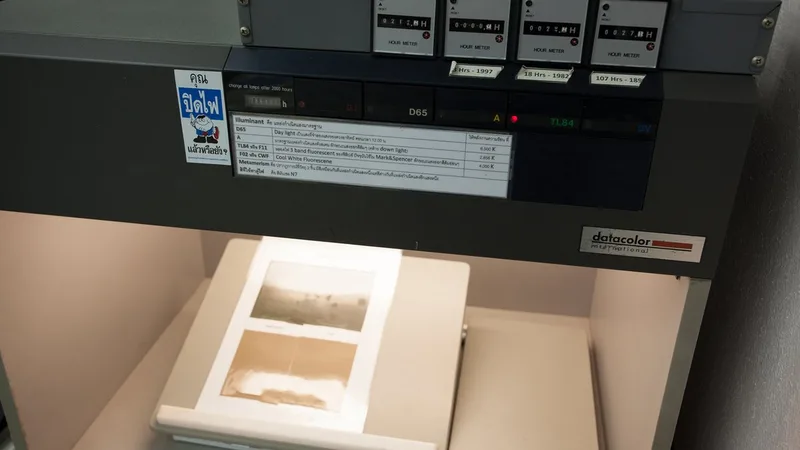
- Colour consistency across lots — the mill's colour lab uses a spectrophotometer and a multi-source light booth, and every lot is measured against the approved lab dip.
- Test results with named methods — the in-house lab tests to ISO, JIS, AATCC and Daimaru standards.
- Visible quality checkpoints — three checkpoints: greige inspection before dyeing, in-process control and inspection at packing, with a 10-point system quality report for every lot.
What do fabric traders still add?
- Variety — many constructions and colours from several mills in one place, useful when one order mixes several specs.
- Smaller quantities per order — traders hold stock of many constructions, so they can supply amounts a mill would not take on for dyeing.
- Extra services — cutting to the requested length or width, packing per order, and after-sales service.
- A simpler first step — for a first-time buyer, a trader removes some of the complexity of dealing directly with a mill.
- Worth asking any trader: which mill made the lot, what test reports it carries (method names and grades), and whether it keeps a lot reference for matching re-orders.
How to check quality, whichever channel you buy from
- Always ask for test results that name the method, the grade and the condition: washing fastness ISO 105-C06 / AATCC 61, light fastness ISO 105-B02 (rated on the blue-wool scale 1-8), rubbing fastness ISO 105-X12 and shrinkage ISO 6330 / AATCC 135.
- The 10-point system is a defect-scoring method: each fault scores points according to its length, and the common rule is that the total points per roll must not exceed the yards inspected.
- Ask for the 10-point system quality report for every lot — and if you buy through a trader, ask for both the test reports and the 10-point report, then match the lot before cutting.
When is buying direct from the mill worth it?
- Large repeat orders — uniforms, workwear, hotel linen: the same colour re-ordered in many lots.
- Strict specs — tenders or TORs that name the test methods.
- Many colours on the same base cloth — a colour lab keeps the shades consistent across colours.
- Re-orders months later — the mill keeps the approved standard to compare against.
- Multi-fibre blends — each fibre needs its own dye class and process to land one matching shade, which needs deep dyeing expertise.
- And when a trader is the better fit: one order mixing many constructions, smaller test runs, or a first-time buyer still checking the market.
The BC Capital route: greige, dyeing and finishing under one roof
BC Weaving, part of the BC Capital group, weaves greige fabric on dobby air-jet looms. Boonchuay Industrial (BCI) — a commission dyeing and finishing mill with over 60 years of operation in Nakhon Pathom — takes the cloth through pretreatment, dyeing and finishing.
BCI runs all three dyeing routes (batch jet, continuous, semi-continuous cold pad batch), keeps a colour lab with a spectrophotometer and a multi-source light booth, and its in-house lab tests to ISO, JIS, AATCC and Daimaru standards. Quality is checked at three checkpoints: greige inspection before dyeing, in-process control and inspection at packing, with a 10-point system quality report for every lot.
Colour can start three ways — a spec, a sample to match, or a standard swatch card — and the minimum order (MOQ) is negotiable.
If you are preparing to send cloth for dyeing, read the step-by-step checklist for sending greige for dyeing, the 10-point inspection system and when to pick from standard swatch cards first.
FAQ
Can I buy from a dyeing mill in small quantities?
The MOQ is negotiable — it depends on fabric type, volume and colour. A mill that runs both batch and continuous dyeing can match the process to the volume, so a small job is a conversation, not an automatic no.
Does fabric from a dyeing mill come with test reports?
At BCI the in-house lab tests to ISO, JIS, AATCC and Daimaru standards, and every lot carries a 10-point system quality report.
Is buying direct from the mill always cheaper?
Not automatically — cost follows the batch size per colour. Compare the same spec and the same quantity from both channels before deciding.
How do I get a repeat order to match the original colour?
The approved lab dip is kept as the standard, and every lot is measured against it with a spectrophotometer. Keep your own copy of the lab dip and the lot reference.
What should I ask any fabric supplier?
Which dyeing route will be used; which test methods, grades and conditions; how shade is kept consistent across lots; which quality checkpoints are in place; and whether a 10-point report will be provided.
Talk to BCI
- One-Stop Service: greige, dyeing and finishing
- BCI's commission fabric dyeing service
- Contact the BCI team