
Short answer: the four document sets you need before export
A smooth fabric export does not start at the container — it starts with "four document sets" the buyer must receive from the mill before bulk production: the approved lab dip, the fabric spec sheet, test reports to agreed standards (ISO, JIS, AATCC or Daimaru) and the commercial documents (commercial invoice, packing list, certificate of origin, bill of lading). This article walks through each set: what it is, what it is for, and how to prepare it so the shipment does not stall.
Why export starts with documents, not fabric
The same fabric can ship to many different markets, each with its own rules and standards. The documents are the "language" in which customs, the buyer and the inspector all talk about the same roll of fabric. A job with complete documentation moves faster through release steps, and it reduces the chance of a claim after the fabric reaches the buyer — which costs far more than fixing the paperwork up front — and costs the buyer's trust as well.
Approved lab dip: the colour everyone accepts
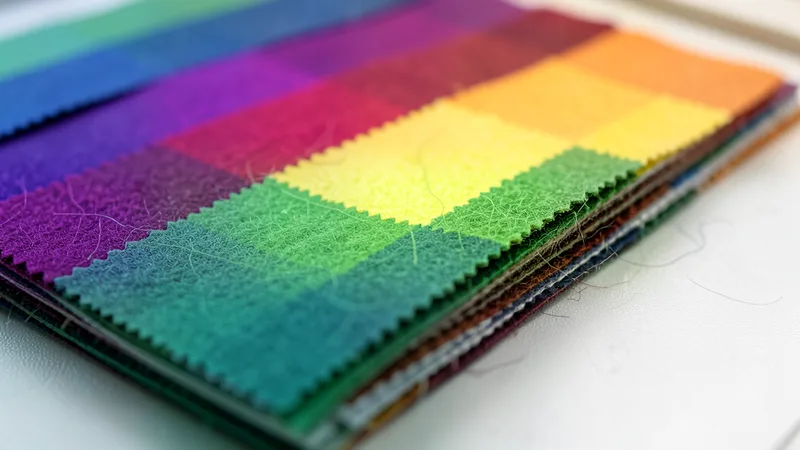
The lab dip is a laboratory-dyed sample used to approve the colour before bulk production.
- The buyer uses the lab dip as the colour reference for the whole order.
- Once approved, the colour is recorded as a formula and measured values (such as L, a, b or delta E) for comparison in production.
- When the bulk lot is finished, its colour is measured against the lab dip with a spectrophotometer — if it falls outside the agreed limit, the mill must correct it before shipment.
Approving the lab dip is therefore "signing off the colour" — both sides share one standard, and there is no colour argument at inspection. (Read more: what a lab dip is)
The fabric spec sheet: what to write down
The spec sheet is the document that condenses every requirement of the fabric into measurable values.
- Fabric type and fibre content, e.g. TC, TR or polyester.
- GSM and the acceptable tolerance.
- Finished width and length per piece.
- Colour: referenced to the lab dip or a standard colour system such as Pantone.
- Required functions or finishes, e.g. water-repellent, easy care, quick dry, anti-bacterial.
- The standard used for testing each item.
A spec written as "measurable values" removes far more room for interpretation than a spec written in words — because numbers can be re-measured and compared across lots.
Test reports: ISO, JIS, AATCC and Daimaru
Export work usually names the testing standard in the contract or spec. In general:
- ISO — the most widely used international standard in export.
- JIS — the Japanese standard, common in the Japanese and Asian markets.
- AATCC — the United States standard.
- Daimaru — the Japanese standard used in specific trade lines.
Common items on a test report include colour fastness (to light, water, perspiration and washing), shrinkage, rubbing fastness, tear and tensile strength, and any special-function values — the buyer should state the "pass/fail" value for each item in the spec in advance, so the report can be read directly as "pass" or "fail". (Read more: fabric quality testing)
The sampling flow: from spec to bulk
The standard sequence a buyer should know, and use to track progress:
- Receive the spec sheet — confirm every value before anything starts.
- Lab dip — approve colour (and hand) before any other step.
- Production sample — fabric from the actual production lot, at the step agreed, checked against the spec.
- Bulk production — production runs to the approved spec.
- Inspection before delivery — a quality report for every lot, before packing.
- Commercial documents ready for shipment — the final set before the container moves.
A buyer who knows this sequence can ask the right question at every stage: which step is the job at, and which document must be finished by when.
The basic commercial documents: four to know
- Commercial invoice — names seller, buyer, fabric items, quantities, value and terms; it is the principal document for customs.
- Packing list — lists pieces, weights and packing of every lot; it is used to verify the goods on receipt.
- Certificate of origin — shows that the fabric was made in Thailand; it is used to claim preferential tariff treatment under international agreements.
- Bill of lading (B/L) — the shipment document for sea freight and a document of title in its own right; verify the consignee and destination port.
Details of each document and the formats used in practice can be studied at the U.S. Commercial Service, a government agency that explains export documents in depth.
Documents and standards by destination market
Different destination markets "emphasize" different checks, and a buyer can prepare in line with the market.
- Japanese market — JIS and Daimaru standards are commonly used; buyers often ask for complete shade records for every lot.
- US market — AATCC standards are central, together with fastness values and function values.
- European market — ISO standards are used alongside chemical-compliance requirements; buyers often ask for test results on restricted substances.
- Southeast Asian markets — usually reference ISO, with emphasis on shade and quality consistency.
The common point: the clearer the destination's standards, the less room for argument at inspection — and fewer claims afterwards.
How to ask the mill for complete documentation: step by step
- List the documents you need — a checklist covering the lab dip, spec sheet, test reports and the four commercial documents.
- Name the test standard per item — for example "colour fastness to washing to the ISO standard" — precise is better than just "test results".
- Agree document timings — when each document must be ready, e.g. lab dip before production, test report before delivery.
- Name a document contact — one person on the mill's side and one on yours, to track status.
- Ask for digital copies — keep every document in one place, ready to produce the moment an inspection happens.
For a mill used to export flow, this list is not a burden — it is "normal procedure" that makes the whole job faster.
Common traps: what slows an export down
- Bulk starts before the lab dip is approved — risking a re-dye of the whole lot, which is far harder to fix than a sample.
- The spec has no pass/fail values — the test report becomes a list of raw numbers everyone interprets differently.
- No production sample check — errors that should surface at sample stage surface at full-lot stage instead.
- Commercial documents disagree with the spec — fabric name, colour or quantity mismatched between documents stalls release immediately.
- No report requested at every step — when a problem appears, you cannot prove the lot was produced to spec.
All of this is prevented by "agreeing the documents before production" — something any first-time buyer can do today, on every order. The simple principle: a good document is one that can be re-verified, without having to ask the mill again.
First export? A practical checklist
For buyers who have not exported fabric before, start with this order:
- Confirm the destination market's requirements (standards, documents and certification needs) before starting the job.
- Build a spec sheet with measurable values, and have the mill sign it.
- Approve the lab dip, and record the colour values as the comparison baseline.
- Agree pass/fail values for each test item, and the timing of the report.
- Ask for a production sample before full bulk production.
- Verify that the four commercial documents match the spec and the actual lot.
- Keep one complete set of documents in one place, ready to produce at any time.
If you can complete these seven steps, your first export is likely to run more smoothly than you expect.
At BCI: lab dip, spec and test reports for export jobs
Boonchuay Industrial (BCI) in Nakhon Pathom has run commission dyeing and finishing for over 60 years. The BCI team works to the standard sequence — lab dip in the colour laboratory (spectrophotometer, multi-source light booth, automatic lab colour dispenser), production to spec, and issuing the 10-point quality report with test results to ISO, JIS, AATCC and Daimaru (see all dyeing and finishing services and lab and standards).
Before an export job, the BCI team helps prepare the full document checklist from the start — from colour approval to the pre-delivery report — and you can contact the team directly to talk through your export.
FAQ
Q: What documents do I need for a fabric export to be complete? A: At minimum: the approved lab dip, the spec sheet, test reports to the agreed standard, and the commercial set (commercial invoice, packing list, certificate of origin, bill of lading). All four sets together make the job "deliverable" at every step.
Q: Why must the testing standard (ISO/JIS/AATCC) be named in the spec? A: Because test methods and limits differ between standards. If you do not state "standard + pass value", the report becomes numbers that can be read several ways. Naming it up front closes the interpretation gap.
Q: How is a production sample different from a lab dip? A: The lab dip is a laboratory sample for approving colour and hand; the production sample is fabric from the actual production lot — it checks both the spec and the lot's "representativeness". If the production sample passes, the full lot is likely to pass as well.
Q: Is the certificate of origin important for exports? A: Very — it is the evidence of origin used to claim preferential tariff treatment under international trade agreements, and many destination markets require it in the export document set.
Q: If a lot fails the test report, what should the buyer ask for next? A: A correction plan from the mill (such as re-dyeing or cutting out the affected sections) plus a re-test report — and keep the records of every lot as the baseline for the next order.