
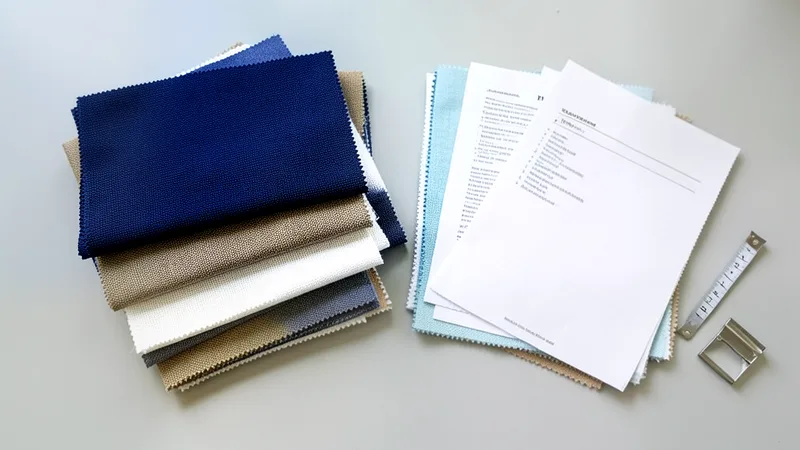
A fabric spec sheet is the written description of exactly what the fabric you are ordering should look like, feel like and do. Most supply problems between a buyer and a mill start with a spec that was ambiguous from the beginning. This guide walks through every line of a standard spec sheet, explains what each value tells you, and lists what to ask your mill for before you place an order.
What a fabric spec sheet is
A spec sheet (also called a fabric specification) lists the measurable properties of a fabric: fibre composition, weight, width, shrinkage, dye type and finishes. It turns "the same as last time" into a document both sides can check. When a roll arrives, the spec sheet is the reference that inspection is measured against.
In a group that both weaves and dyes, like Boonchuay Group (BC Weaving for greige, Boonchuay Industrial for dyeing and finishing), the spec also carries information from the weaving stage, such as yarn count and construction, so the dyeing and finishing teams know exactly what they are working with. Whatever the supply chain looks like, the goal is the same: one document, one set of numbers, no guesswork.
The spec sheet, line by line
Mills use different layouts, but a complete spec always covers the same properties. Check each line against your requirements before you approve a sample.
- Composition: the fibre content, for example 100% cotton, 65/35 TC or 60/40 TR. It decides drape, care instructions and how the fabric dyes.
- GSM: grams per square metre, the fabric weight. It drives cost, hand feel and suitability for the end use. Mass per unit area is measured by standard methods such as ISO 3801.
- Width: usually in inches or centimetres. Always confirm the finished, usable width, because selvedge and shrinkage reduce it. ISO 22198 describes how width is measured.
- Shrinkage: the change in length and width after washing, as a percentage. This line decides whether panels still match after the customer washes them. ISO 5077 is a common test method.
- Yarn count and construction: for example a 30/1 yarn in a 2/1 twill. It describes the structure and lets you compare equivalent cloths across mills.
- Dye type and colour reference: whether the fabric is piece-dyed, yarn-dyed or printed, and the approved lab dip number to match.
- Colour fastness requirements: each fastness the end use needs, with its minimum grade and its exact test method, for example washing (ISO 105-C06 or AATCC 61, with the test condition such as A2S or C2S), rubbing dry and wet (ISO 105-X12 or AATCC 8), light (ISO 105-B02 or AATCC 16.3), perspiration (ISO 105-E04), water and chlorine. Uniforms, hospital wear and outdoor fabric need different levels, so write them per end use.
- Test method version, model and equipment: the same fastness test exists in several standards, editions and test conditions, and runs on different machines, such as wash-fastness testers, crockmeters and xenon-arc light testers. Each can give a different grade on the same fabric. Name the standard, its edition and test condition, and for critical tests the lab or equipment, so buyer, mill and any third-party lab read results the same way.
- Finishes: functional finishes such as quick-dry, easy care or anti-bacterial, plus the expected hand feel.
- Lot numbers and tolerances: how dye lots are identified and what variation in GSM, width and colour is accepted between lots.
Why vague specs cause production problems
When the spec is vague, each party fills the gaps differently. Common failures:
- Colour drift between dye lots that were never tied to a reference, so every reorder looks different.
- Shrinkage that was never tested, so panels cut from the same order no longer match after washing.
- Width recorded at the wrong stage, so cutting plans and material costs are off on every order.
Each of these is cheap to prevent on paper and expensive to fix on the shop floor. The spec sheet is the cheapest quality control you will ever buy.
What to ask your mill for before ordering
Before bulk production starts, get these in writing:
- A signed spec sheet that matches your requirements, with tolerances for GSM, width and colour.
- An approved lab dip before any bulk dyeing. See how our commission dyeing process confirms colour on a lab dip first.
- Shrinkage results after the wash cycle your customers will actually use.
- A clear lot-numbering system, so every roll can be traced back to its dye lot.
- The inspection standard for finished rolls. Point systems are the norm: the 4-point system in ASTM D5430 is widely used, and Boonchuay grades finished fabric with a 10-point system.
Build your own spec sheet template
Don't rely only on the mill's format. Keep a master template with the same lines every time, plus columns for the approved reference sample, the approval date and the person who signed off. When you change suppliers or reorder years later, the template is what keeps the fabric the same.
A good template also has room for handling notes: ironing temperature, recommended wash cycle, and known behaviour such as a tendency to pill or fade. These notes cost nothing to write and prevent arguments later.
FAQ
Q: What is a fabric spec sheet?
A: The document that lists every agreed property of a fabric (composition, GSM, width, shrinkage, dye type, finishes and tolerances) and is the reference for inspection.
Q: What GSM tolerance should the spec state?
A: Agree a band, for example plus or minus 5%, because small weight variation is normal. The right band depends on the fabric and the end use, so state it explicitly.
Q: How is fabric width measured?
A: Across the fabric, edge to edge, with the fabric relaxed. The loom figure is the woven width, but the finished width after dyeing and finishing is what you cut on, so confirm both.
Q: Is a spec sheet the same as a test report?
A: No. The spec states the agreed target values; a test report is the measured result on a physical sample. Inspection checks the gap between the two.
Q: Why must the spec name the test method, not only the grade?
A: Because the same fabric can score a different fastness grade under a different standard, test condition or machine. A grade without its method cannot be checked or compared.
Q: Who should sign the fabric specification?
A: Both the buyer and the mill. A signed spec is the reference for inspection and for any dispute, so agree every number before production starts.
If you are specifying fabric for uniforms, hospital wear or another technical use, our team can help turn your requirements into a complete, inspection-ready spec sheet. Contact us with your fabric details.
References
- ISO 3801:1977 Textiles: Woven fabrics: Determination of mass per unit length and mass per unit area (AFNOR)
- ISO 22198:2006 Textiles: Fabrics: Determination of width and length (Swedish Institute for Standards)
- EN ISO 5077:2008 Textiles: Determination of dimensional change in washing and drying (Swedish Institute for Standards)
- ASTM D5430 Standard Test Methods for Visually Inspecting and Grading Fabrics (ASTM International)