
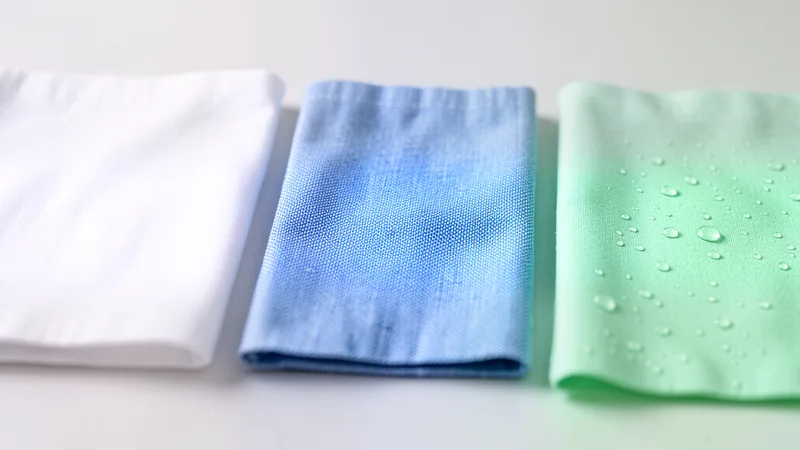
Hospital fabric is chosen by application: operating-theatre scrubs and gowns are most often TC (cotton–polyester) or TR (rayon–polyester) because they take repeated high-temperature laundering and hold their colour, 100% cotton where breathability matters most, and 100% polyester for strength and fast drying. Functional finishes such as antibacterial and water-repellent are then specified on top of the base fabric.
The practical way to buy: decide the garment (scrub, gown, patient uniform, bandage fabric), then the fibre, then write the finish and the test requirements — including the named test method — into the spec before production.
Four main uses of hospital fabric
- Operating doctor scrubs / patient uniforms: must survive repeated commercial high-temperature laundering without losing colour or shape — TC and TR are the most common choices
- Medical gowns: need to resist liquid penetration — a water-repellent finish is a key part of the spec
- Patient uniforms and bed textiles: 100% cotton for comfort and breathability; TC for durability and easier care
- Bandage fabric for coating: the buyer must state the construction and the coating requirement, because the base cloth has to suit the coating process and keep its dimensions stable
Choosing the fibre: cotton, TC, TR, polyester
- 100% cotton: high moisture absorption and breathability, comfortable to wear — but it shrinks and creases in the wash, so cotton for hospital use is usually mercerized (for strength, smoothness and better colour take) and sanforized (to lock dimensional stability)
- 100% polyester: strong, quick-drying, crease-resistant, but absorbs little moisture
- TC (cotton–polyester): combines both sides — cotton's feel and absorbency with polyester's durability and shrinkage control, and holds colour through repeated hot laundering
- TR (rayon–polyester): a softer, smoother hand than TC — suited to comfort-driven uniforms
- Research on medical scrub fabrics confirms that fibre type, weave structure and weight are the main variables that set the balance between comfort and barrier performance — so the spec should state all three clearly
Finishes for clinical use
- Anti-bacterial finish: reduces microbial growth on the fabric; efficacy is measured quantitatively to ISO 20743 (three quantitative methods: absorption, printing, transfer) — state the test method and pass grade in the spec
- Water-repellent finish: makes liquid bead up and run off instead of soaking in — important for gowns and clothing that must resist contaminated fluids
- Soil-release finish: helps stains come out during washing
- Easy-care / quick-dry finish (moisture management): shortens drying time in a hospital laundry cycle
- Deodorant finish: for long-wear applications
- Mercerizing + sanforizing: not functional finishes but cotton processes that add strength, smoothness, colour take and dimensional stability
Tests to request from the factory (always a named method)
Every fastness and performance claim should be backed by a test to a named standard method and condition:
- Wash fastness: ISO 105-C06 (or AATCC 61) — the standard covers domestic and commercial laundering up to 70°C and notes that hospital articles may be subjected to more severe procedures — state your actual laundry programme in the spec
- Chlorine fastness: for programmes that use chlorine-based disinfection
- Perspiration fastness: for garments worn against skin for long shifts
- Rubbing fastness (dry and wet)
- Dimensional stability / shrinkage: ISO 6330 (or AATCC 135) — critical for patient uniforms and bed textiles that are laundered repeatedly
- Tensile and tear strength: for gowns and bandage cloth that are handled and coated
- Water-repellency test: for gown/scrub fluid repellency
- Antibacterial activity: ISO 20743
- Bleeding test: for items laundered together with other colours
- Ask for a per-lot test report against the agreed spec before release — that is normal mill QC practice
OEKO-TEX STANDARD 100: the safety layer
OEKO-TEX STANDARD 100 is a textile safety standard that tests for harmful substances, with four product classes set by how close the article is to the skin: Class I (articles for babies) and Class II (articles with direct skin contact) — the more intensive the skin contact, the stricter the limit values. For hospital garments and bandage cloth that touch skin, agree which product class the lot must be certified to.
How to order hospital fabric
- Define the garment and usage conditions (laundering programme, disinfection, hours of wear)
- Specify fibre, construction, weight and width
- Specify colour: send a sample to match, a colour code, or choose from a standard swatch card — the mill dyes a Lab Dip and you approve it before production
- Specify finishes and the test spec — method, condition and pass grade
- Minimum order is negotiable: it depends on the fabric, the finish and the volume, and BCI runs both batch and continuous dyeing to suit different volumes
- Before release: lab test report + fabric inspection to the QC system
At Boonchuay Industrial (BCI)
Boonchuay Industrial (BCI) in Nakhon Pathom has over 60 years of commission dyeing and finishing experience and supplies hospital and medical fabric directly: operating doctor uniform fabric, medical gown fabric and bandage fabric for coating, in TC, TR, 100% cotton and 100% polyester, with anti-bacterial, water-repellent and soil-release finishing available. BCI holds ISO 9001, ISO 14001 and OEKO-TEX STANDARD 100 certification. Its in-house laboratory tests against the agreed spec using ISO, JIS, AATCC and Daimaru methods — shade, hand feel, shrinkage and the required functional property — before each lot is released, with a 10-point quality report. See the Hospital & medical fabrics page and contact sales.
FAQ
Q: Why are hospital scrub programmes mostly TC or TR? A: Because they must survive repeated commercial high-temperature laundering and keep colour and shape. TC balances cotton's absorbency with polyester's durability and shrinkage control; TR gives a softer, smoother hand. 100% cotton is chosen where breathability is the priority, 100% polyester where strength and drying time matter.
Q: What test proves a fabric will survive hospital washing? A: Wash fastness to ISO 105-C06 (or AATCC 61) at the temperature and programme of your laundry, plus dimensional stability to ISO 6330. Any other wash method (for example a home wash) gives a grade that cannot be compared — that is why the standard method must be named in the spec.
Q: How long does an anti-bacterial finish last? A: It depends on the finishing agent and the washing programme. Ask the mill to state the tested performance (for example, activity after N washes to ISO 20743) and agree the grade in the spec before production.
Q: Can bandage fabric for coating be ordered? A: Yes — it is part of the medical textile range. Send the construction and the coating requirement to sales, because the base cloth has to suit the coating process.
Q: What is the minimum order for hospital fabric? A: The minimum is negotiable. It depends on the fabric, the finish and the volume, and sales will agree a quantity for your specification.
References
- OEKO-TEX® STANDARD 100 — OEKO-TEX Association. https://www.oeko-tex.com/en/our-standards/oeko-tex-standard-100
- ISO 105-C06:2010 Textiles — Tests for colour fastness — Part C06: Colour fastness to domestic and commercial laundering — ISO. https://www.iso.org/standard/51276.html
- ISO 20743:2013 Textiles — Determination of antibacterial activity — ISO. https://www.iso.org/standard/59586.html
- Effect of ZnO nanoparticles on the mechanical and functional properties of medical scrub fabrics — Journal of Umm Al-Qura University for Applied Sciences (Springer). https://link.springer.com/article/10.1007/s43994-025-00307-5
- Textiles as fomites in the healthcare system — review, European PMC. https://europepmc.org/article/MED/37199751