
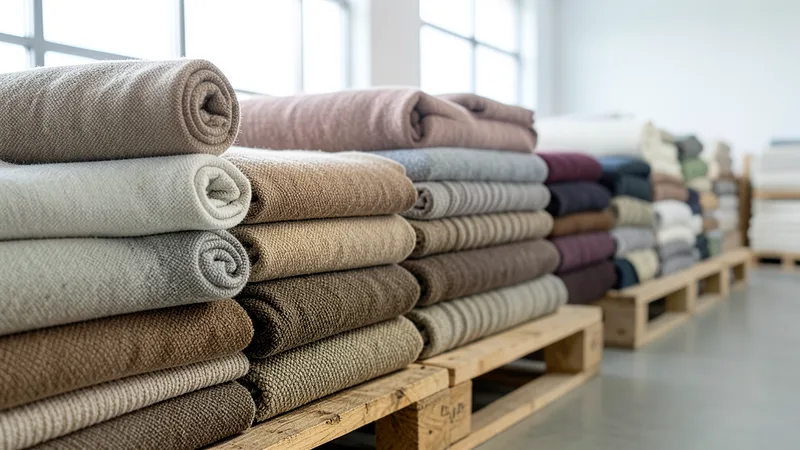
Short answer: good storage is cool, dry, dark and ventilated
Storing fabric so it stays in usable condition comes down to four things — a cool, dry, dim and well-ventilated space; rolls that never touch the floor (racks or pallets); full labelling of every roll; and first-in, first-out (FIFO) rotation. Fabric, especially natural fibres, absorbs moisture from the air — high and fluctuating humidity is the leading cause of mould, colour change and weight/size drift.
Why warehouse conditions matter
Fabric is hygroscopic — fibres take up moisture from the air and release it again as conditions change.
- High humidity — mould grows easily, and cellulosic fibres (cotton, rayon, Tencel) are at most risk — the Canadian Conservation Institute notes that relative humidity (RH) of 65–100%, warm temperatures and poor air circulation allow mould to grow
- Heat and light — UV fades dyes and embrittles fibres; Cotton Incorporated points out that storing in the dark and ventilating well reduces fabric yellowing
- Humidity swings — fabric expands and contracts with moisture, affecting the length and width it measures and putting stress inside the yarn structure
- Dust, fumes and chemicals — soiling can feed mould even on polyester
Recommended warehouse conditions
- Temperature: 18–25°C, avoid hot spots (the U.S. National Park Service recommends 18–20°C for textiles, never above 24°C)
- Relative humidity: below 65% — 50–60% is safer (CCI: below 60% with good airflow, mould is unlikely)
- Consistency — steady conditions matter more than the number: daily swings make fabric swell and shrink repeatedly
- Light: no direct sun; storage rooms should be dim
- Ventilation: no engine exhaust or chemical fumes (Cotton Inc. recommends ventilated storage and keeping combustion vehicles out of warehouses)
- Monitoring: a temperature/RH meter, checked regularly — especially in the rainy season
How to stack fabric rolls
- On racks or pallets, at least 15 cm off the floor — never directly on concrete
- Do not over-stack — the weight of the upper rolls creases and deforms the lower ones
- No dropping, no dragging — move rolls with trolleys
- Keep rolls in their original wrapping (film/paper) until they are cut
- Group by article/colour/lot — easy to find, and no cross-shipment
By fibre type
- Cellulosic fibres (cotton, rayon, Tencel, bamboo) — the most absorbent, the most mould-prone: control humidity strictly
- Polyester — does not absorb water; mould-free under normal conditions, and only moulds when soiling or residues feed it
- Blends (e.g. TC, TR) — somewhere in between, depending on the fibre ratio
Labelling dye lots and rotating (FIFO)
Label every roll with:
- article code + colour/shade name
- dye lot number
- quantity (yards/metres) + date in
- record it into your system and run FIFO — first in, first out
Why dye lots must not be mixed: cloth dyed in different lots can differ slightly in shade. Mixing lots within one garment run makes the colour uneven from piece to piece — the mill's quality report confirms the shade of each lot.
Moving and cutting
- Move rolls with trolleys or lifting aids — never drag or drop
- Transport: protect from rain and sun, do not crush, and load on pallets
- Cut from the roll end, keep the cut end tidy, and re-wrap in the original material
Found mould or damage? What to do
- Isolate immediately — move it to a cool, dry, ventilated place so it cannot spread
- Document: photos + article code + lot/roll number + affected quantity
- Notify the mill with the lot's quality report — for investigation and resolution
- Find the cause (leaks, drips, humidity) before putting the rest of the fabric back in storage
Boonchuay Industrial (BCI)
BCI (Boonchuay Industrial), in Nakhon Pathom, inspects fabric in three layers — greige inspection before dyeing, in-process checks, and inspection at packaging before delivery. Every roll that passes is documented in a 10-point system quality report, together with results from BCI's own lab tests (colour fastness, strength, shrinkage, etc., against ISO, JIS, AATCC or Daimaru, as the buyer specifies).
For more, read fabric quality testing and see BCI's standards at BCI lab & standards.
FAQ
Q: How long can fabric be stored?
A: There is no fixed shelf life — in a cool, dry, stable warehouse, fabric can be kept for many months to years. Natural-fibre fabrics are at mould risk if humidity climbs.
Q: What humidity is safe?
A: Below 65% RH — aim for 50–60%. Consistency matters more than the number.
Q: Does polyester get mould?
A: Polyester does not absorb water — it stays mould-free under normal conditions and only moulds when soiling or residues feed the organisms.
Q: Why mustn't I mix dye lots?
A: Cloth dyed in different lots can be slightly different in shade; mixing lots in one garment run makes the colour uneven from piece to piece.
Q: Fabric got wet in the rain — what now?
A: Isolate it at once, air-dry it (no harsh sun, no high heat), check its condition, and only return it to storage once it passes.
Contact for commission dyeing
If you are looking for a dyeing mill that documents every roll with a quality report — contact Boonchuay Industrial (BCI) to discuss fabric dyeing and uniform fabrics.
References
- Causes, Detection, and Prevention of Mold and Mildew on Textiles (Conserve O-Gram 16/1), U.S. National Park Service
- Mould Growth on Textiles (CCI Notes 13/15), Canadian Conservation Institute
- Mold and Mildew on Textiles, Museum Conservation Institute (Smithsonian)
- Overview of Fabric Yellowing (ISP-1002), Cotton Incorporated