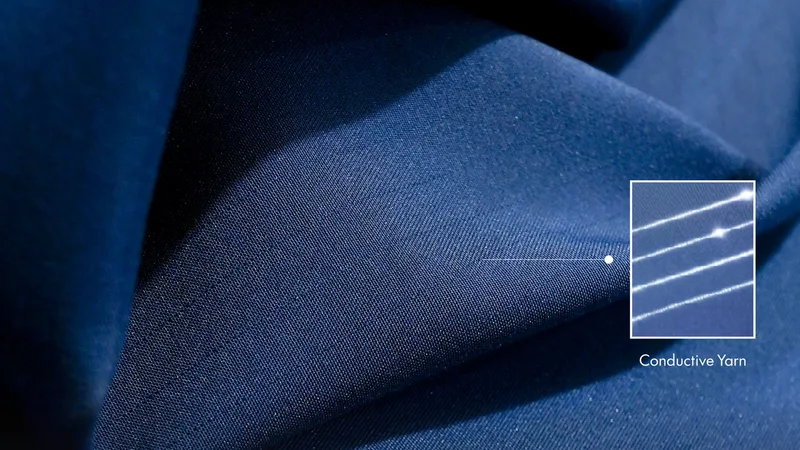
Anti-static fabric is a technical textile designed to control the accumulation and transfer of static electric charge across the fabric. In electronics manufacturing, cleanrooms, component factories and laboratories, accumulated charge can attract dust to surfaces and disrupt production. This type of fabric is therefore made into work garments for areas where static electricity must be controlled.
What Is Anti-Static Fabric?
Static electricity arises from the transfer of electrons between materials when they rub against, touch or are separated from one another. If the charge cannot dissipate, it accumulates on the surface of the material.
Some synthetic fibres have low electrical conductivity and absorb little moisture, so they accumulate charge more readily than fibres that absorb moisture well, such as cotton. However, the electrical behaviour of a fabric does not depend on the fibre type alone. It also depends on the fabric structure, moisture, finishing agents and conditions of use.
The term Anti-Static does not mean that a fabric never generates static electricity. It means a fabric designed to keep the accumulation and transfer of charge at a level suited to its use.
Fibres and Yarns Used in Anti-Static Fabric
The materials used fall into two main groups:
- Conductive fibres or yarns, such as carbon yarn, which help spread or dissipate electric charge.
- Base fibres of the fabric, such as Polyester, Nylon, Recycled Polyester, Cotton, Polyester-Cotton and Polyester-Rayon, used as the main material or together with conductive yarn.
Carbon Yarn
Carbon yarn is a yarn that contains carbon or another conductive material, so it can help create a path for electric charge to spread away from the area where it has built up. The performance of the yarn should be considered together with its electrical resistance, the structure and size of the yarn, the proportion of conductive material, and its durability through weaving, dyeing and finishing.
Weave Structure
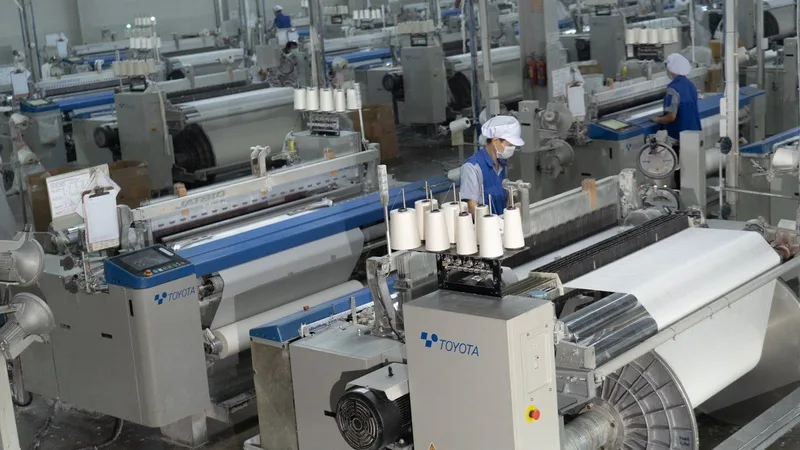
Weaving machines producing greige fabric in an industrial textile manufacturing process
The weave determines how conductive yarn is distributed across the fabric, taking into account the warp yarns, weft yarns, weave pattern, density, weight and thickness of the fabric. Key factors include:
- The position and spacing of the conductive yarn lines
- The continuity of the conductive yarn lines across the whole piece
- The density of the weave structure
- The weight and thickness of the fabric
- The uniformity of the fabric
- The suitability of the fabric structure for its intended use
If the yarns are spaced too far apart or placed unevenly, electrical values may differ from one area of the fabric to another. Greige fabric should therefore be inspected for structure, weight, width, surface appearance and the position of the conductive yarn before it moves on to the next process.
Fabric Preparation, Dyeing and Finishing
Fabric preparation removes oils, dirt, lubricants and residues left from weaving, so that dyeing and finishing are even. Dyeing and finishing affect dye uptake, colour evenness, the adhesion of finishing agents, surface appearance, shrinkage and the performance of the finished fabric.
Finishing adds properties to suit the intended use, for example:
- Anti-Static: a finish that helps control the build-up of static electric charge
- Soft Finish: adjusting the hand feel to be soft
- Quick Dry: a finish that helps the fabric dry quickly
- Water Repellent: a finish that gives the fabric water-repellent properties
- Oil Repellent: a finish that gives the fabric oil-repellent properties
- Soil Release: easy cleaning, helping dirt and stains come out easily
- Dimensional Stability Control: controlling shrinkage and keeping the fabric's dimensions
- Fabric Shape Retention: improving the fabric's shape retention
Some finishing agents may become less effective after repeated washing, so testing should be carried out both before washing and after washing, according to actual use cycles.

Greige fabric woven with red conductive yarn
Quality Control by BCI

Textile quality testing laboratory
The BCI textile quality testing laboratory checks the properties of the fabric before delivery. The inspection covers the following topics:
- Electrical properties
Items checked: Electrical resistance, charge generation and charge decay
Purpose: To evaluate the electrical behaviour of the fabric according to the test method - Physical properties
Items checked: Weight, width, shrinkage, strength and surface appearance
Purpose: To check quality and suitability for use - Colour properties
Items checked: Shade, evenness and colour fastness
Purpose: To control colour quality and durability - Fabric uniformity
Items checked: Random sampling from the beginning, middle and end of the piece
Purpose: To evaluate the uniformity of the fabric along the whole roll - Durability
Items checked: Comparison of properties before and after washing
Purpose: To evaluate whether properties persist after use - Traceability
Items checked: Fabric code, production lot, test method and test results
Purpose: To trace the production history and inspection results
Before testing, the fabric should be conditioned, with the temperature, relative humidity, conditioning time, number of test specimens and the test method standard clearly specified, because these conditions directly affect the measured property values.
Relevant Standards and Test Methods
The standard or test method should be chosen to suit the type of material, the purpose of the product and customer requirements. Relevant examples include:
- BS EN 1149-1: method for measuring specific resistance on the surface of a material (Surface Resistivity)
- BS EN 1149-2: method for measuring the electrical resistance through the thickness of a material (Vertical Resistance)
- JIS L 1094: test method for the tendency of textiles to generate static electricity; the specific sub-method used should be clearly stated
- AATCC TM76: test method for the electrical resistivity of textiles
- ASTM D257: test method for DC resistance or conductance of insulating materials; its suitability should be considered before applying it to textiles
- ISO 6330: method for washing and drying textiles to evaluate properties after washing; it is not a direct test of anti-static properties
Before stating that a product “passes”, the standard and its edition/year, the test method, the test conditions and the acceptance criteria should be clearly specified, based on customer requirements or the product standard. Naming a standard alone does not confirm that a product passes the criteria or is automatically certified to that standard.
Industrial Applications
Anti-static fabric can be used to make:
- Industrial uniforms and workwear
- Garments for electronics factories
- Garments for cleanrooms
- Lab coats
- Specialty textiles
Each application has different requirements, for example fibre type, fabric weight and strength, breathability, comfort, durability and washing method. For cleanrooms or areas with specific risks, additional cleanliness and safety requirements should be considered, and fabric or garments that have passed testing against the relevant criteria should be chosen, rather than judging by anti-static properties alone.