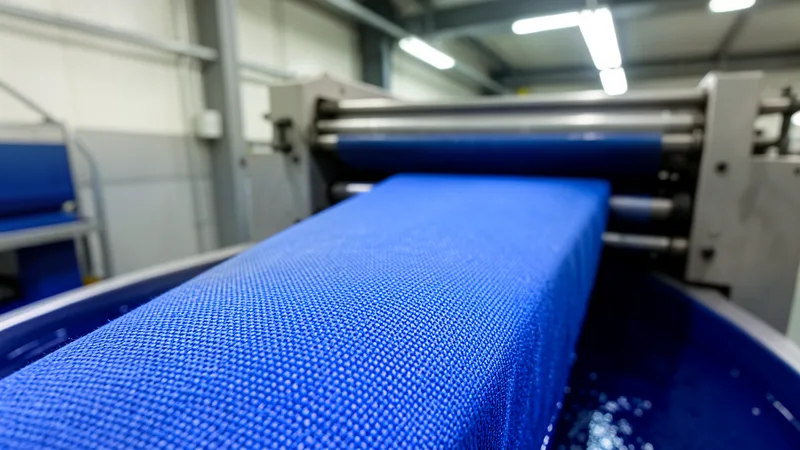
Commission dyeing (contract dyeing) means sending greige fabric from a weaving mill to a dyeing and finishing factory that bleaches, dyes and finishes it to your exact specification — instead of buying off-the-market finished fabric with a limited colour range.
A commission dyeing mill takes care of the whole process: pretreatment, dyeing, finishing and quality control before delivery, with the approved lab dip as the colour reference for the entire lot.
Why commission dyeing instead of buying finished fabric
- Exactly the colour you want — market fabric comes in whatever colours happen to be in stock; with commission dyeing you match a Pantone code, a swatch or a sample garment, or pick a standard colour from the mill's swatch cards
- Specs built for your use case — you define weight (GSM), width, required colourfastness and finishing properties such as wrinkle resistance, soil release or water repellency
- Colour consistency across the lot — the mill controls dyestuff recipe and process parameters so every piece matches the approved sample
- Works at any business size — from apparel brands, uniforms and hospital textiles to export orders
For large production runs, the most common failure is not the fabric price — it is a shade that drifts from the sample, or a batch that fails the end customer's quality tests. Controlling the job from the lab dip through to the production lot is exactly why larger brands choose commission dyeing.
The 6 steps of commission dyeing
- Specification & colour reference — send your specification, send a colour sample for us to match, or choose a standard colour from our swatch cards. Then send your greige fabric (or place an order to have it woven and dyed together).
- Lab dip — the mill's colour lab dyes a small quantity so you can approve the shade before bulk production; the approved lab dip becomes the standard for the whole lot
- Pretreatment — singeing, desizing, scouring, bleaching and, for cotton, mercerizing: removing impurities and preparing the fibre so the dye takes evenly
- Dyeing — the dyeing route and dyestuff class are matched to the fibre, the shade and the order volume
- Finishing — the fabric receives the properties your spec requires: easy care, water repellency, moisture management (quick dry), or a smooth soft hand
- Quality control & packing — inspection at greige intake, in-process checks and final inspection before packing, with a quality report
The three dyeing routes a wet-processing mill uses
- Jet (exhaust) dyeing — batch dyeing with hot liquor circulated through the cloth; suited to deep shades, bright colours and high-levelling work
- Continuous dyeing — the fabric travels through the dyeing range continuously; suited to large volumes with fast throughput, in light to dark shades
- Semi-continuous (cold pad batch) dyeing — the cloth is padded with dye, rolled up and left to fix at room temperature for several hours, then washed off; suited to work that needs high uniformity and good colourfastness
The right route depends on fabric, shade and volume. A good mill will recommend the route that fits your spec and is economical for your order.
Dyestuff classes, chosen by fibre
Wet-processing mills work with several dyestuff families and will match them to your fibre:
- Reactive dyes — for cotton and cellulosic blends such as TC and TR; bond chemically to the fibre for good wash fastness
- Disperse dyes — for polyester
- Vat dyes — for cotton and cellulosic fabric; the most durable colour against washing, light and chlorine bleach, and a speciality of Boonchuay Industrial
- Acid dyes — for protein fibres and some synthetics
- Direct dyes — for cotton; economical for medium-to-light shades
- Pigment dyes — work on many surfaces with a simple process
- Natural dyes — for special products with a natural-dye story
The dyestuff class affects fastness and end use directly, so naming your fabric clearly from the start helps the mill choose the right dye. Boonchuay Industrial dyes cellulosic fabric with both reactive and vat dyes, and specialises in vat dyeing for buyers who need the most durable colour, such as workwear and uniforms that are washed hard. Blended fabrics such as TC and TR are the most demanding: each fibre needs its own dye class and process, and both must end up as one matching shade. The more kinds of fibre in a blend, the more expertise and technique the dyeing takes.
Finishing: chemical and mechanical
After dyeing, the fabric is finished to your specification:
- Chemical finishes — water repellent, water and oil repellent, soil release, flame retardant, easy care, moisture management (quick dry), anti-mosquito/insect/pollen, anti-bacterial and deodorant
- Mechanical finishes — calendering, sanforizing (shrink control), air tumbling, raising, shearing, sanding and brushing
Each finish changes how the cloth behaves: for example, sanforized fabric resists shrinking in the wash, which matters a lot for uniforms and hospital textiles.
Boonchuay Industrial: over 60 years of commission dyeing
Boonchuay Industrial is a commission dyeing and finishing mill in Sam Phran district, Nakhon Pathom province, with over 60 years of experience. It is part of the BC Capital group, which runs the full chain from weaving (BC Weaving) through dyeing and finishing (BCI) to sales and export (BC Link) — so a job can be managed from greige fabric all the way to finished cloth.
What the mill offers:
- A complete colour lab — spectrophotometer, multi-source light booth, automatic lab dyestuff dispenser, and lab dyeing in both batch and continuous modes that duplicates the production process
- All three dyeing routes — jet (exhaust), continuous and semi-continuous (cold pad batch), covering light to dark shades across small lots and high-volume work
- An in-house testing lab — colour fastness to washing, rubbing, perspiration, light, water and chlorine, plus dimensional stability and tear/tensile strength, tested to ISO, JIS, AATCC and Daimaru standards
- Quality and environment systems — ISO 9001, ISO 14001 and OEKO-TEX® STANDARD 100, which certifies that the fabric has been tested free of harmful substances
What to prepare before you send work
- Fabric details — fabric type (e.g. TC, TR, cotton), weight (GSM), width and quantity
- Colour — Pantone code, a swatch or a fabric sample
- Quality spec — the colourfastness levels you need and the standard test method for each, for example ISO 105-C06 or AATCC 61 for washing (the same fabric can grade differently under a different wash method, so naming the method keeps buyer and mill reading the same result), plus the finishing required and the standards your end customer specifies
- Minimum order (MOQ) — terms differ from mill to mill; at Boonchuay Industrial the minimum order is negotiable, depending on fabric and volume
Frequently asked questions
What is the minimum order for commission dyeing
It depends on fabric, shade and volume — at Boonchuay Industrial the minimum order is negotiable. Contact the mill with your fabric type and quantity to discuss the terms.
Can I send just my greige fabric for dyeing
Yes — you can send greige fabric you wove or bought elsewhere for dyeing and finishing, or use the group's integrated structure, from weaving (BC Weaving) to dyeing (BCI) to sales (BC Link), to manage the job from greige to finished cloth.
Can wrongly dyed fabric be redyed
It depends on the dyestuff class and the fabric — some shades can be overdyed, but not all. The best protection is to examine and approve the shade carefully at the lab dip stage.
Why does an in-house colour lab matter
Because the mill can test your shade in small quantities before bulk production, so the bulk lot matches the approved sample — reducing the risk of shade deviation. Boonchuay's lab includes a spectrophotometer and a multi-source light booth.
How long does dyeing take
It depends on fabric, shade and volume; the clock generally starts when the lab dip is approved — ask the mill about the terms for your specific job before committing.
How do I choose a fabric dyeing factory
Check that the dyeing factory has the dyeing routes your job needs (jet, continuous, semi-continuous), its own colour lab and testing lab, tests to named standards such as ISO or AATCC, runs a quality system such as ISO 9001, and has experience with your fibres and blends. Then ask for a lab dip and a test report before bulk production.
Start a job with Boonchuay
See our dyeing and finishing services on the commission dyeing page or contact us to discuss your order. For the technical side, read how to read a fabric spec sheet first — it will make your briefing to the mill much clearer.
References
- Thailand Textile Institute (THTI) — thaitextile.org
- Thailand: Textile Industry — Thailand Board of Investment (BOI) — boi.go.th
- OEKO-TEX® STANDARD 100 — International Association for Research and Testing in the Field of Textile Ecology — oeko-tex.com
- AATCC — American Association of Textile Chemists and Colorists — aatcc.org