Greige (grey) fabric is woven cloth straight off the loom that has not been dyed, bleached, printed or finished — it still carries the warp sizing and natural impurities, which is why it looks cream to grey and feels stiff. Before greige goes to a dyeing mill, a buyer should check three things: weaving faults, sizing uniformity and cleanliness — because anything left in the greige gets dyed in and cannot be removed later.
What is greige (grey) fabric, and why is it grey?
Greige fabric is cloth immediately after weaving, before any bleaching, dyeing or finishing. Its cream-to-grey colour is the natural, unbleached colour of the cloth — not a colour anyone dyed.
Two things make greige look dull and feel stiff:
- Warp sizing — a coating (starch, or synthetic polymers such as PVA) applied to the warp yarns before weaving so they survive the friction and tension of the loom. After weaving, the size is still on the cloth.
- Natural impurities — waxes, pectins, oils in the fibre, and dust and dirt picked up in the weaving shed.
Greige is not ready for use — it has to go through pretreatment before it can take dye or bleach evenly.
What should you check when you receive greige?
Greige is the raw material of dyeing and bleaching: any fault that is missed at inspection will show up clearly once the cloth is dyed. Check these:
- Weaving faults — broken ends, missed picks, doubled yarns, stains, shadows or structure irregularities. Run the cloth over a lit inspection frame and cover the whole width.
- Sizing uniformity — uneven size means the cloth will absorb water and dye unevenly, which shows as patchy or streaky dyeing.
- Cleanliness — machine-oil marks, dust or foreign fibre picked up in the weaving shed.
- Spec consistency — width, weight (GSM) and weave structure must match the spec sheet or delivery slip.
- Roll and packing condition — greige rolls normally travel unwrapped; check for damage, creases or bulges on the roll.
Finding a fault before dyeing is far cheaper than finding it in the finished dyed cloth — which is why a good dyeing mill inspects the greige again before the job starts.
What does a dyeing mill do to greige before dyeing?
Greige cannot take dye straight away: the size and the natural waxes block dye from reaching the fibre. The pretreatment line runs in this order:
- Singeing — the cloth passes very fast over flames or hot plates that burn off loose surface fibres, leaving a smoother face.
- Desizing — the warp size is washed out. For starch sizes, the common route is enzymatic desizing: an amylase enzyme breaks the starch into water-soluble material. Incomplete desizing is a classic cause of patchy dyeing.
- Scouring — a hot alkaline wash that removes the natural waxes, oils and impurities so the cloth wets and dyes evenly.
- Bleaching — for white goods, to bring the cloth to an even, high white level.
- Mercerizing — for cotton, to add lustre, strength and better dye uptake.
BCI runs a full pretreatment line covering all of the above, and its in-house lab tests to ISO, JIS, AATCC and Daimaru standards.
How is greige different from finished fabric?
- Colour — greige is its natural cream-to-grey colour; finished fabric is dyed or bleached.
- Sizing — still on greige; removed from finished fabric.
- Hand — greige is stiff and rough; finished fabric has been softened and sized for the intended hand.
- Dimensional stability — greige can still shrink in the wash; finished fabric has been size-set (sanforized / stentered).
- Purpose — greige is a raw material; finished fabric is ready for cutting or use.
Weaving and dyeing under one roof: the BC Capital one-stop service
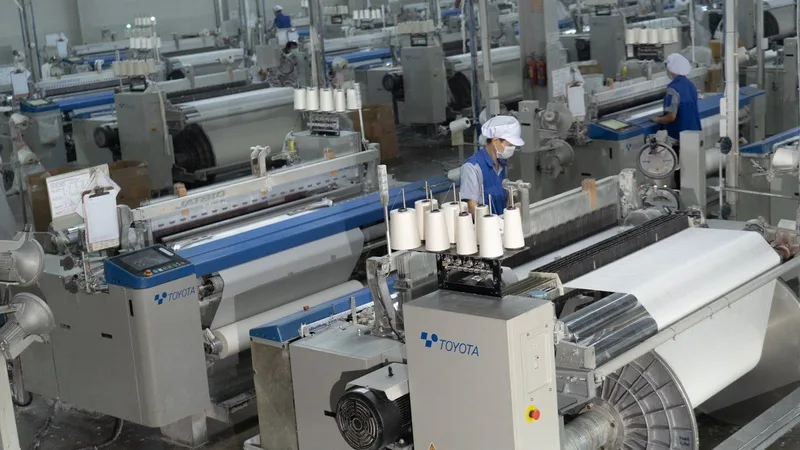
BC Weaving, part of the BC Capital group, weaves greige fabric on advanced dobby air-jet looms that give flexibility and consistency across many constructions. Boonchuay Industrial (BCI) — a commission dyeing and finishing mill with over 60 years of operation — takes over from bleaching through dyeing to finishing.
The benefit for the buyer: BCI checks quality at three checkpoints: greige inspection before dyeing, in-process control and inspection at packing, with a 10-point system quality report for every lot.
The colour side can start three ways: send a colour spec, send a sample to match, or pick from standard swatch cards. And the minimum order (MOQ) is negotiable.
If you have not sent cloth for dyeing before, read the step-by-step checklist for sending greige for dyeing and the 10-point inspection system first.
FAQ
How is greige different from bleached (white) fabric?
Bleached fabric has already gone through the bleaching step, so it has an even white colour. Greige is unbleached and still carries its warp size — in short, white fabric is greige that has been bleached.
What happens if the size is not fully removed before dyeing?
Leftover size blocks the dye from penetrating the fibre evenly, so the cloth dyes patchy, streaky or with uneven depth. That is why sizing uniformity matters at the greige-inspection stage.
Does BCI inspect greige before dyeing?
Yes — greige inspection before dyeing is BCI's first quality checkpoint, followed by in-process control and inspection at packing. Every lot carries a 10-point system quality report.
Is TC greige prepared differently from cotton greige?
Yes — the size and the natural impurities differ (100% cotton carries natural waxes and proteins), so the pretreatment recipe and time differ. BCI dyes TC, TR and cotton.
What is the MOQ for commission dyeing?
The MOQ is negotiable — it depends on fabric type, volume and colour. Talk the details through with the BCI team.
Talk to BCI
- One-Stop Service: greige, dyeing and finishing
- BCI's commission fabric dyeing service
- Contact the BCI team