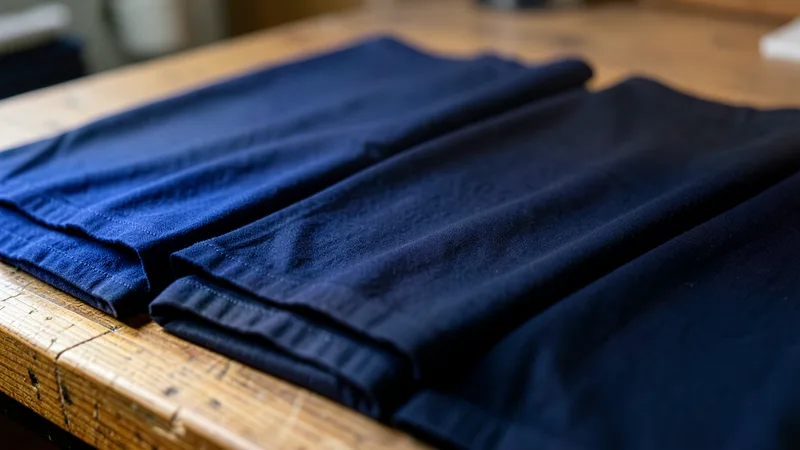
Vat dyeing is a dyeing method for cotton and other cellulosic fabrics in which the dye is first reduced to a soluble form, taken up by the fibre, and then oxidised back inside the fibre to a strong, insoluble colour.
The result is the most durable colour class on cotton — top wash, light and chlorine fastness — which is why vat-dyed fabric is the standard choice for workwear and uniforms that are laundered again and again.
What is a vat dye
- Vat dyes are manufactured in an insoluble, oxidised pigment form
- In the dye bath, a reducing agent in alkaline solution converts the dye into a soluble "leuco" form that the cotton fibre can absorb
- Once inside the fibre, the dye is re-oxidised — by air or hydrogen peroxide — back to the insoluble, coloured form, trapped inside the fibre for good
- The name "vat" comes from the large vats in which dyers traditionally prepared the reduced dye liquor
- Vat dyes are used mainly on cellulosic fibres: cotton, rayon and Tencel
- Two families: anthraquinone-based dyes (the majority, with superior fastness, especially to light) and indigoid dyes (indigo — the classic blue of denim — and related shades)
Why vat dyes are so fast
- The dye is physically trapped in the fibre as an insoluble particle — there is nothing to bleed out into the wash water
- Cotton Incorporated's dye-class comparison rates vat dyes Good–Excellent for wash, light and chlorine fastness, and Good for perspiration — the best all-round fastness package on cotton
- Reactive dyes also reach Good–Excellent wash fastness (they form a covalent bond with cellulose), but they typically rate only Moderate–Good for light fastness and Poor–Good for chlorine
- So for repeated industrial laundering (uniforms, workwear) or chlorine contact (pools, sports), vat-dyed fabric keeps its colour longer
- The trade-off: vat shades run deeper and duller — there are few bright yellows, oranges or reds — and the class is strongest in blues, greens and blacks. Bright, clear fashion shades are a reactive-dye job
Vat vs reactive: how to choose
- Fixation: vat = insoluble particle trapped in the fibre / reactive = covalent chemical bond with cellulose
- Wash fastness: both Good–Excellent (reactive, when well washed off)
- Light fastness: vat Good–Excellent / reactive Moderate–Good (light shades weaker)
- Chlorine fastness: vat Good–Excellent / reactive Poor–Good
- Shade range: reactive is brighter and wider / vat is strongest in deep blues, greens and blacks
- Process: vat needs precise control of the reduction and oxidation steps / reactive is more forgiving
- Typical use: vat for workwear, uniforms, towels and garments that must survive repeated washing / reactive for apparel, bright shades, fast colour changeover
When to specify vat dyeing
- Uniforms and workwear that go through a commercial laundry many times a year
- Outdoor or covered exposure, and chlorine contact (pool, sports)
- Deep, stable shades: navy, black, dark green, blue
- On TC (cotton–polyester) blends, the vat dye fixes on the cotton part only; the polyester part must be dyed with disperse dyes — blends therefore need a mill's deep dyeing expertise so the final shade matches across the fibre components
Vat dyeing at Boonchuay Industrial
- Boonchuay Industrial (บุญช่วยอุตสาหกรรม), Nakhon Pathom — over 60 years in textile dyeing and finishing
- Dyes cellulosic fabric with both reactive and vat dyes, and specialises in vat dyeing for the most durable colour (wash, light, chlorine)
- Runs all three main dyeing routes — exhaust (jet), continuous and semi-continuous (cold pad batch) — to match volume and shade
- Colour laboratory: lab dip with a spectrophotometer and a multi-source light booth, automatic lab colour dispensing, and batch and continuous lab dyeing that duplicate the production process
- In-house testing: wash, light, water, perspiration and chlorine fastness, crocking, dimensional stability, tear and tensile — to ISO, JIS, AATCC and Daimaru standards
- Certified to ISO 9001, ISO 14001 and OEKO-TEX® Standard 100
- 10-point quality report before packing
Frequently asked questions
What is the difference between vat and reactive dyes
In short: vat dye is trapped in the fibre as an insoluble particle and delivers the best all-round fastness in the class; reactive dye bonds chemically to cellulose and offers a brighter, wider shade range, but weaker light and chlorine fastness.
Is vat-dyed fabric really colourfast — how do I verify
Yes — that is the class's strength. Verify it with named test methods: wash fastness to ISO 105-C06 / AATCC 61, light fastness to ISO 105-B02, chlorine fastness to ISO 105-E01 — and ask the mill for a test report against your own specification, so you can be sure the colour will not bleed under repeated laundering.
Do uniforms have to be vat-dyed
Not always — but for uniforms laundered commercially many times a year, vat dyeing gives the longest colour life, especially in navy and black. Reactive dyeing is a valid, more economical option when the fastness requirement is moderate.
Can vat dyes dye TC fabric
Yes, for the cotton part: the vat dye fixes only on the cellulose, while the polyester part must be dyed with disperse dyes — a blend needs the mill's deep dyeing expertise so the final shade matches.
Are vat-dyed fabrics safe to wear
Check third-party certification: Boonchuay Industrial is certified to OEKO-TEX® Standard 100, which means its fabrics are tested for harmful substances.
Specify vat dyeing where colour must last
If your uniforms or workwear must keep their colour through repeated industrial washing, specify vat-dyed fabric in your spec and request the fastness test report. See our fabric dyeing services and uniform fabrics, or talk to our team on the contact page.
References
- ISP-1001 Colorfastness of Cotton Textiles — Cotton Incorporated — cottoninc.com
- Textile Dyeing (Dyeing Booklet) — Cotton Incorporated — cottonworks.com
- TRI-3018 Colorfastness for Woven Fabrics — Cotton Incorporated — cottoninc.com
- AATCC Standard Test Methods (AATCC 61, AATCC 8, AATCC 16.3, AATCC 188) — AATCC — aatcc.org