
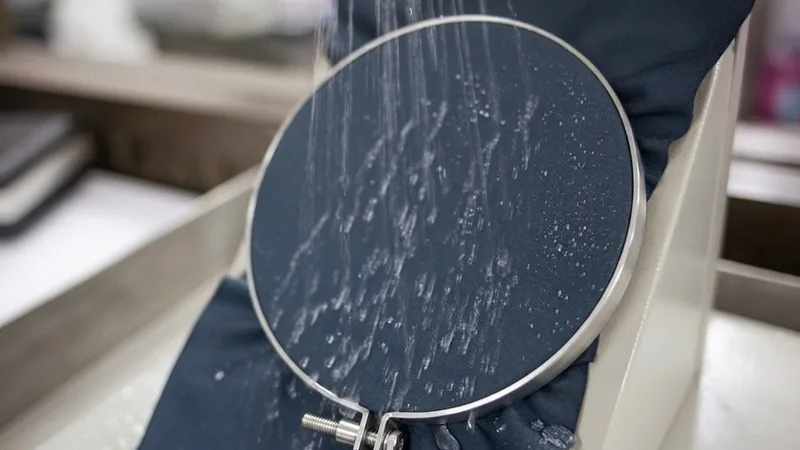
Water-repellent fabric is cloth finished with a DWR (durable water repellent) chemical that makes water bead into round droplets on the surface instead of soaking in or spreading. But water-repellent is not the same as "waterproof": this finish protects against "surface wetting", not "water penetration" — a distinction that matters for the spec, because the test method and the value you specify are different.
What is a water-repellent (DWR) finish?
DWR (durable water repellent) is a chemical surface treatment that lowers the surface energy of the fibres and the cloth face, so water cannot spread across the surface — it gathers into droplets and rolls off. A ZDHC research report defines DWR as a textile finish whose performance attributes may include water repellency, oil repellency, stain repellency, soil repellency, and durability to use, "e.g. to laundering, dry cleaning, abrasion, light exposure, rain, etc."
- The water-repellent finish is one step of chemical finishing, applied to dyed or bleached cloth
- It comes as a temporary (non-durable) or durable (DWR) version that survives multiple washes
- The chemistry may be fluorinated or non-fluorinated — the buyer can ask the mill which chemistry is used and ask for proof that the fabric is free of harmful substances
- DWR may be applied by padding, exhaustion or spray, depending on the mill and the fabric
Why use a water-repellent finish?
- Keeps liquid out of the cloth — the face stays cleaner, wipes off easily, and the colour and surface finish stay clean longer
- Light and breathable — a DWR finish adds almost no weight and does not block vapour the way a coating or membrane does
- Reduces surface soiling — water that beads up carries surface dirt off with it when it rolls off
- Match the exposure — for jobs that only meet drizzle or splashes, a DWR finish is enough without the cost and feel of a full waterproof build
- Can be combined with other functions — e.g. water and oil repellency (BCI offers the water and oil repellent finish) or other finishes as the use requires
How is water-repellent different from "waterproof"?
- Mechanism: water-repellent lowers surface energy so water beads / waterproof has a barrier that blocks water passing through the cloth
- What it handles: light spray, drizzle, splashes / continuous rain or immersion
- Test: spray test — ISO 4920, AATCC TM 22 (measures surface wetting) / rain test — AATCC 35, Bundesmann ISO 9865 (measures penetration)
- The standard's own limitation: the spray test does not measure penetration through the fabric (stated explicitly in ISO 4920 and AATCC TM 22)
- A truly "waterproof" garment usually combines "DWR + membrane/coating" — the DWR keeps the surface from wetting so the membrane lasts longer
How is water repellency measured?
The main methods used in buying:
- ISO 4920 — mount the specimen at 45 degrees, spray 250 ml of water from a nozzle in 25-30 s, compare the wetted pattern to the standard scale — spray rating 0-5: 0 = entire face fully wetted, 1 = wetted beyond the spray points, 2 = partial wetting beyond the spray points, 3 = wetting at the spray points only, 4 = slight random sticking or wetting, 5 = no sticking or wetting at all
- AATCC TM 22 — same principle, photographic chart of 0, 50, 70, 80, 90, 100 (0 = fully wetted, 100 = no wetting)
- Penetration test (if required) — AATCC 35 (rain test: 5-minute spray, weigh the blotter paper for the water that passed through) or ISO 9865 (Bundesmann rain-shower test)
- The result is a "score" for the sample, not a certification of the cloth itself — the buyer and the mill must agree the minimum value in the spec
- The test report should always state the method (standard) and the sample preparation conditions, so results can be compared across lots or across mills
A peer-reviewed study (Hill et al., 2020, AATCC Journal of Research) found that the standard 25-30 s shower is much shorter than real rainfall — extending the shower duration helps distinguish DWR chemistries that score similarly on the standard test.
BCI's in-house lab tests water repellency to ISO, JIS, AATCC and Daimaru standards.
How long does the finish last?
- DWR wash durability depends on the chemistry, the application and the end use — there is no single number that fits every finish
- The finish wears away gradually with washing and abrasion
- The standard way is to specify: "target spray rating + wash count to re-test" (e.g. test to ISO 4920 before and after N washes) and compare the values
- Buyers with continuous outdoor use should include a wash-count re-test in every spec
- In practice, a worn-out DWR finish can be re-applied to the same cloth (re-finish), depending on the fabric and the mill's capabilities
Where is it used?
The main uses are jobs that meet water occasionally but do not need a full waterproof build:
- Outdoor workwear/uniforms — field work, deliveries, ground services exposed to light rain or splashes
- Home textile: curtains, sofa covers, cushions, seating — liquids wipe off easily and the fabric lasts longer
- Fashion/casual — outdoor clothing that should shrug off drizzle without the feel of waterproof fabric
- Where both water and oil repellency are needed — e.g. kitchen or oil-industry work; BCI also offers the water and oil repellent finish
Common mistakes about water-repellent fabric
- "DWR = waterproof" — it is not: DWR only keeps the "surface" dry; under pressure or prolonged rain, water can still penetrate. A full waterproof build needs a barrier/membrane (tested by a different method)
- "A high spray score = ready to ship" — the spray score is a score for the sample; the spec must state the minimum value, and re-test after washing to know the real durability
- "The chemistry must be harmful" — DWR chemistry comes in fluorinated and non-fluorinated families; ask the mill which one is used and ask for certification that the fabric is free of harmful substances (e.g. OEKO-TEX Standard 100)
- "The finish lasts forever" — DWR wears away gradually with washing and abrasion; the wash count for re-testing belongs in every spec
- "Any test method works" — ISO 4920 and AATCC 22 use different scales (0-5 vs 0-100); name one standard in the spec so results can be compared without confusion
How to specify water-repellent fabric
- Fabric type and weight (GSM) — follow the fabric spec sheet
- Function required: water-repellent only, or water + oil repellent
- Test method and target value: e.g. "ISO 4920 spray rating at least ... / AATCC 22 rating ..." — set the value to the actual exposure of the use
- Wash count used for the re-test (wash durability)
- Chemical requirements: e.g. the fabric must be certified to OEKO-TEX Standard 100 (BCI holds this certification)
- The minimum order (MOQ) for a finished job is negotiable
Does BCI do water-repellent finishing?
Boonchuay Industrial Co., Ltd. (BCI) — a commission dyeing and finishing mill in Nakhon Pathom with over 60 years of experience — offers water-repellent finishing, and water and oil repellent finishing, as part of its chemical finishing service, with an in-house lab that tests water repellency to ISO, JIS, AATCC and Daimaru standards.
On quality: BCI checks three checkpoints: greige inspection before dyeing, in-process control and inspection at packing, with a 10-point system quality report for every lot. BCI holds ISO 9001, ISO 14001 and OEKO-TEX Standard 100 certifications.
Read more: the 9 functional finishes guide and BCI's commission fabric dyeing service.
FAQ
How is water-repellent different from "waterproof"?
Water-repellent keeps the "surface of the cloth" dry — water beads and rolls off — but if water is pressed on or kept on long enough, a DWR finish may still let "water penetrate". A waterproof fabric has a barrier (e.g. a membrane) that blocks penetration — tested differently: ISO 4920 (surface) and AATCC 35 / ISO 9865 (penetration).
What do the ISO 4920 grades mean?
The 0-5 scale measures the "wetting pattern" after spraying: 0 = entire face fully wetted ... 5 = no wetting at all — the higher the grade, the better the repellency. The "pass" value is not set by the standard; it is agreed between the buyer and the mill (per the ZDHC report: the standard does not define pass/fail).
How many washes does the finish last?
It depends on the DWR chemistry, the application and the wash conditions — there is no single guaranteed number. The standard way is to state the wash count in the spec and re-test to ISO 4920 or AATCC 22 after washing.
Can TC or TR fabric be made water-repellent?
The water-repellent finish is a finishing step that can be applied to most woven cloth types after dyeing/bleaching — the buyer names the fabric and asks BCI directly whether this finish suits it (the MOQ is negotiable).
Does BCI do water-repellent finishing?
Yes — BCI offers water-repellent (and water and oil repellent) finishing as part of its chemical finishing service, with an in-house lab testing water repellency to ISO, JIS, AATCC and Daimaru standards. Talk the details through with the BCI team.
Talk to BCI
References
- ISO 4920:2012 — Textile fabrics — Determination of resistance to surface wetting (spray test), ISO
- The Art of Testing: Water Repellency, AATCC
- Hill P.J. et al. (2020), Quantifying Water Repellency by Modifying Spray Test Method AATCC TM22..., AATCC Journal of Research (SAGE)
- Durable Water and Soil Repellent Chemistry in the Textile Industry — A Research Report, ZDHC / Outdoor Industry Association